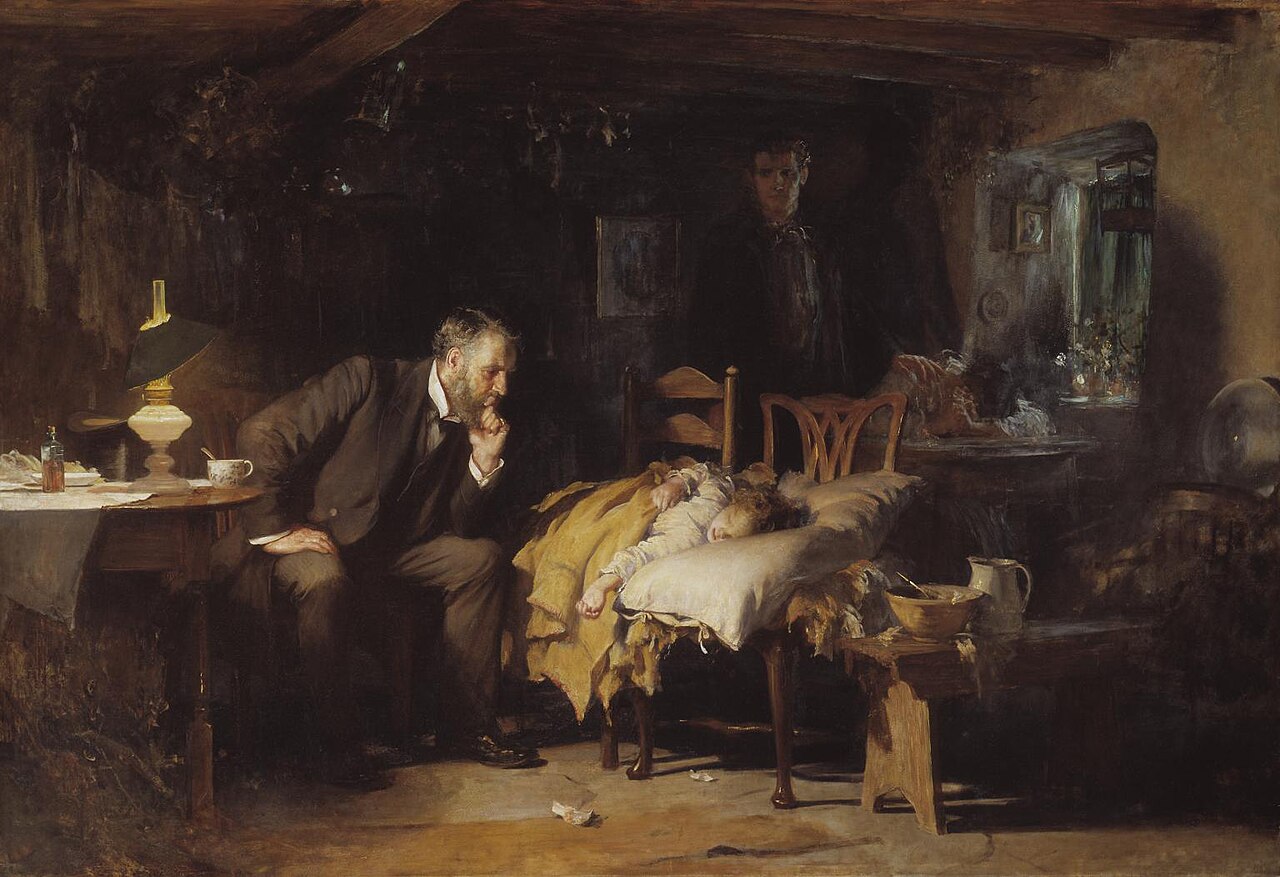
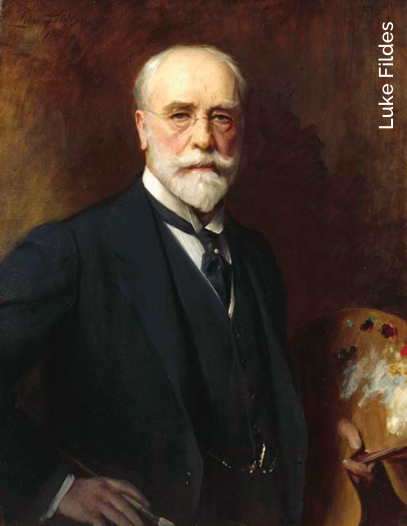
The Doctor by Luke Fildes (1891),
Oil on frame
Death of his one-year-old son, Philip, from
typhoid fever on Christmas morning, compelled
Fildes to paint a picture revolving around the
compassionate Dr. Murray visiting his dying child,
in his humble cottage.
The work is considered one of the most famous
depictions of the practice of medicine and has
been described as "iconic" and has often been
used to illustrate the virtues of a good doctor
Fildes' skilful use of light and perspective focuses
the eye on the doctor & the patient. The parents
are in the shadows, helpless. It is notable that the
stethoscope, thermometer, and other advances
of medical science are nowhere to be seen. Fildes
seemed more intent on focusing our attention on
the art than the science of medicine. Medicine is
thus reduced to ancient fundamentals:
Observation and presence.
The Healing Arts, an illustrated anthology edited
by Downie, includes a print of the picture and this
endorsement:
‘This painting is an eloquent portrayal of what
medicine is all about — the doctor, the patient,
and the quality of the relationship that exists
between them. The physician is attending the
patient, watching and waiting — being there.
Much of the painting's impact is the space
between the physician's eyes and the child, which
is filled, solely, by the patient's gaze.’